
What the AWS UAE Incident Reveals About Cloud SLAs, Recovery, and Geopolitical Risk
Executive Summary
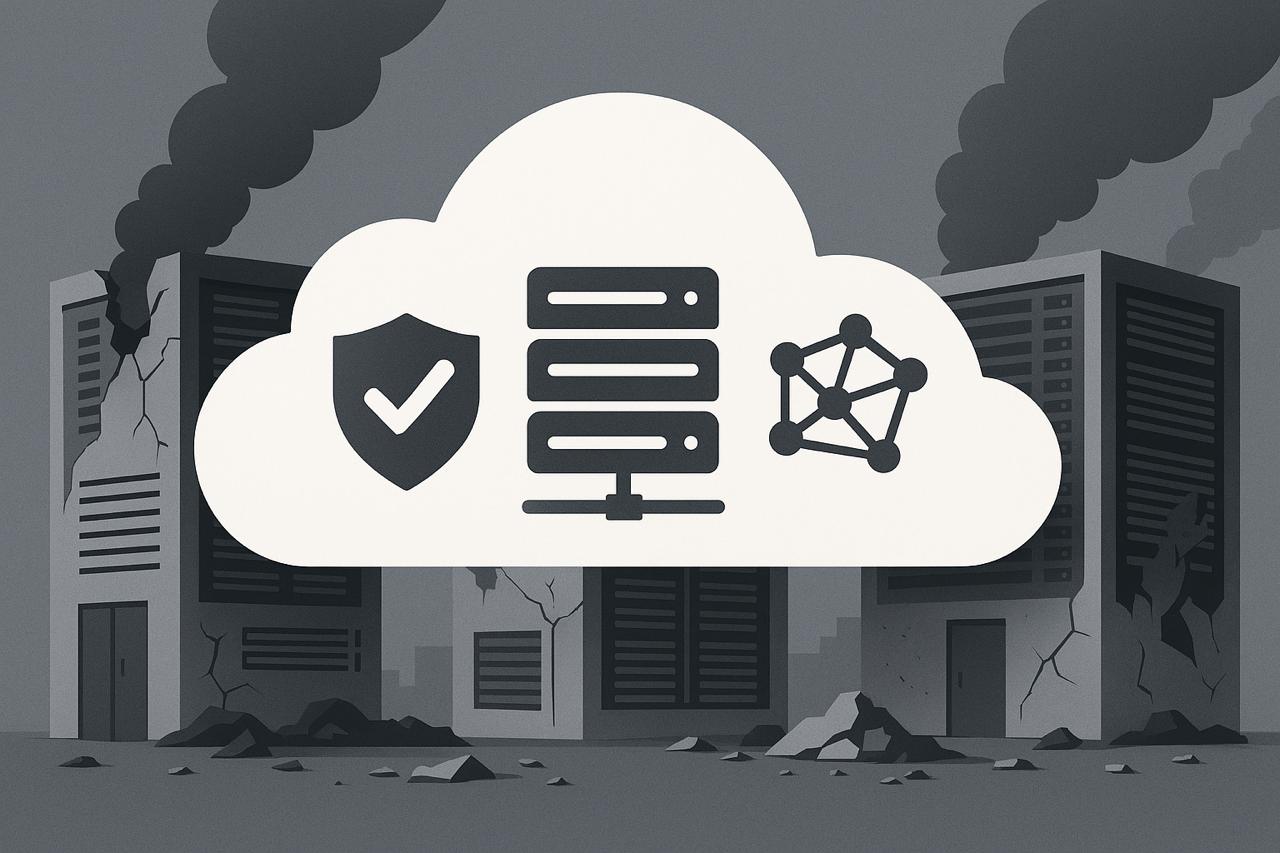
In early afternoon of March 1st 2026, cloud services in the Middle East experienced significant disruption following physical damage to data‑center infrastructure in the United Arab Emirates and Bahrain. Amazon Web Services (AWS) confirmed that multiple Availability Zones in its ME‑CENTRAL‑1 region were affected after external objects struck facilities, triggering fires and power shutdowns. While investigations and official statements remain cautious about attribution, the incident occurred amid an active regional conflict and represents a rare, real‑world test of cloud resilience under extreme geopolitical conditions.
What Happened
On March 1–2, 2026, AWS reported service disruptions in its Middle East (UAE) region after objects struck one or more data‑center facilities, causing sparks and fire. Local authorities shut down power to contain the situation. As a result:
- Two Availability Zones within the ME‑CENTRAL‑1 region were taken offline for a period of time.
- Multiple core services, including EC2, S3, DynamoDB, and networking control APIs, experienced elevated error rates or degraded availability.
- Customers in regulated and consumer‑facing sectors, including financial services, reported application outages.
AWS advised customers to initiate failover to unaffected regions where possible and noted that recovery timelines were dependent on physical inspection, repairs, and coordination with local authorities. Public reporting widely assessed the broader geopolitical context as a contributing risk factor, although cloud providers have not formally attributed causality beyond the immediate physical impact.
This incident is notable not because outages are unusual, but because physical damage in an active conflict zone simultaneously affected multiple Availability Zones within a single region—a scenario that standard high‑availability assumptions rarely consider
SLA Commitments During War and Force Majeure
What Force Majeure Means in Cloud Contracts
All major hyperscalers—including AWS, Microsoft Azure, and Google Cloud—include force‑majeure clauses in their customer agreements and service‑specific SLAs. These clauses typically exclude provider liability and SLA remedies for outages caused by events beyond reasonable control, such as:
- War or armed conflict
- Civil unrest or terrorism
- Government orders or emergency actions
- Natural disasters or large‑scale infrastructure failures
In practice, this means that service credits—the sole remedy under most cloud SLAs—may not apply when outages are caused by qualifying force‑majeure events. Even outside force majeure, SLAs do not cover consequential damages, business interruption, or regulatory penalties.
The key takeaway for customers is not legal technicality but expectation management: SLAs are financial instruments, not continuity guarantees.
What SLAs Actually Promise
Under normal operating conditions, cloud SLAs typically promise:
- Monthly uptime targets (e.g., 99.9%–99.99%)
- Eligibility for usage credits if those targets are missed
- Conditions that assume workloads are architected according to provider best practices (such as multi‑AZ deployment)
What they do not promise is uninterrupted service under extraordinary regional conditions. When multiple Availability Zones are simultaneously impaired by physical events, even well‑architected workloads may fail in ways SLAs were never designed to address.
Gap Exposed by Geopolitical Risk
Most cloud SLAs were written with natural disasters and technical failures in mind—not sustained regional instability, physical attacks on civilian infrastructure, or prolonged access restrictions imposed by authorities. The UAE incident exposes a structural gap between contractual assumptions and emerging risk realities.
Cloud Provider Recovery Commitment
What Providers Can Reasonably Commit To
During the incident, AWS followed patterns common to hyperscaler incident response:
- Frequent updates via public health dashboards
- Clear communication that recovery depended on physical safety and inspection
- Guidance to customers on workload migration and failover options
These actions reflect a mature operational posture. However, they also underline a hard truth: cloud providers commit to best‑effort recovery, not guaranteed timelines, particularly when physical infrastructure and personnel safety are involved.
The Limits of Recovery in Conflict Scenarios
In conflict‑adjacent environments, recovery is constrained by factors no cloud architecture can abstract away:
- Physical repair of power, cooling, and networking systems
- Restricted access to facilities due to safety or military considerations
- Supply‑chain delays for replacement equipment
- Uncertainty around renewed disruptions
Notably, AWS acknowledged that ongoing regional instability could make operations unpredictable—a level of candor that enterprises should treat as a signal to reassess their own risk assumptions.
Regional Risk, Not a Single‑Vendor Issue
Other hyperscalers operate infrastructure in the same geography. A regional event that affects one provider is, by definition, a shared geographic risk. Vendor diversity within the same region does not eliminate exposure to geopolitical disruption.
Key Lessons from the Incident
Multi‑AZ Is Not Multi‑Region
Availability Zones are designed to mitigate localized failures—not regional‑scale physical events. The UAE incident demonstrates that multi‑AZ architectures do not equate to regional resilience. For workloads with high availability or systemic importance, multi‑region designs—potentially spanning countries or continents—are the only viable mitigation.
The Hidden Dependency: The Control Plane
Even where compute or storage capacity remains available, regional control‑plane degradation can prevent:
- Scaling workloads
- Reassigning IP addresses
- Updating routing or security policies
- Executing automated failover
This creates a paradox where capacity exists but cannot be operationally accessed. Separating control planes through multi‑region architectures is as important as data replication.
Geopolitical Risk Must Become a Design Input
Cloud architecture reviews typically consider hardware failure, software defects, and natural disasters. The events of March 2026 demonstrate that geopolitical and conflict risk now belongs in the same category—not as an abstract concern, but as a concrete design constraint.
Regulated Industries Face Systemic Exposure
The reported impact on financial institutions highlights how cloud concentration can create systemic risk. Regulators and boards should reassess whether existing outsourcing and resilience guidelines sufficiently address regional conflict scenarios.
Additional Considerations
Insurance Coverage
Traditional cyber‑insurance policies often exclude acts of war, while property insurance rarely covers third‑party cloud dependencies. Many organizations may discover that outages caused by regional conflict are effectively uninsured.
Data Residency vs. Resilience
Data‑sovereignty requirements can conflict with best‑practice resilience strategies. Regulators may need to consider whether compliance frameworks should explicitly allow—or even require—cross‑region redundancy for critical services.
A Precedent, Not an Anomaly
As cloud infrastructure becomes foundational to national economies, it increasingly resembles other forms of critical infrastructure. This incident is unlikely to be the last time cloud services intersect directly with geopolitical conflict.
Conclusion
The AWS UAE incident is a watershed moment in cloud‑risk thinking. It does not undermine the value of cloud computing, but it does challenge a widespread assumption: that cloud abstractions fully insulate digital services from physical and geopolitical realities.
SLAs remain important, but they are limited. Architectures remain powerful, but they have boundaries. Ultimately, responsibility for resilience is shared: cloud providers supply the building blocks, while customers remain accountable for outcomes.
For organizations operating in or dependent on geopolitically sensitive regions, the lesson is clear. Treat conflict risk as a first‑class design concern, validate multi‑region failover before it is needed, and read force‑majeure clauses with the same rigor applied to security architectures. The cloud is resilient—but it is not immune to the world in which it operates.
Disclaimer: This blog post is intended for analytical and informational purposes only.